The 2026 World Cup will be remembered for many things: the goals, the upsets, and the moment Cristiano Ronaldo’s eyes welled up on the pitch. But for a specific group of data-driven traders, those tears weren’t just a display of passion—they were the resolution of a $45 million financial event.
Welcome to the era of prediction markets, where everything from geopolitical shifts to the moisture on a footballer’s cheek is a tradable asset.
The Rise of the Truth Machines: Polymarket and Kalshi
For years, we’ve looked to “experts” and pundits to tell us what’s going to happen. The results have been… mixed. Prediction markets like Polymarket and Kalshi have flipped the script. Instead of listening to what people say, these platforms track what people are willing to bet.
Polymarket, a decentralized platform built on the blockchain, has seen its volume explode in 2026, reaching billions in total trade. Meanwhile, Kalshi has pioneered the regulated path in the U.S., turning “event contracts” into a legitimate asset class.
These markets aren’t just for gamblers; they are “truth machines.” When millions of dollars are on the line, the noise clears, and the most likely outcome emerges as the market price.
The Most Expensive Tear in Sports History
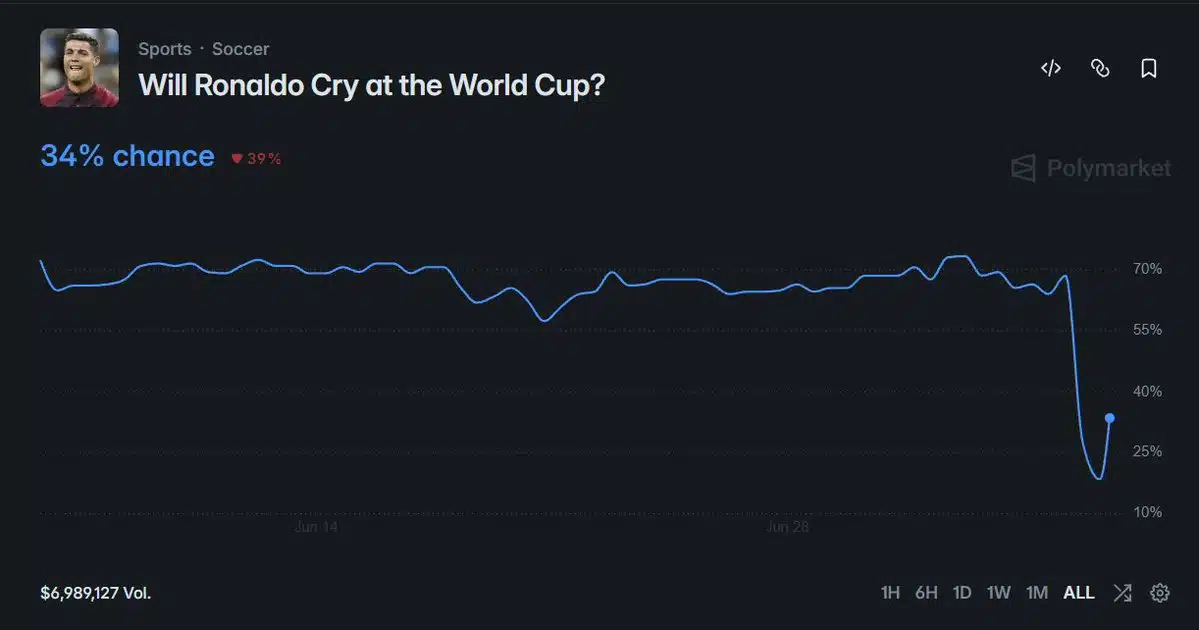
The bet was simple, yet absurdly high-stakes: “Will Cristiano Ronaldo cry during the 2026 World Cup?”
The rules were clinical. For the market to resolve to “Yes,” Ronaldo had to visibly shed tears on his face while on the field or the bench. Crying in the locker room? Doesn’t count.
As Portugal’s journey progressed, the “Yes” shares fluctuated wildly. Every time the camera zoomed in on his face after a missed chance or a tough loss, millions of dollars moved across the globe. By the time the critical moment arrived, the market volume had surpassed $45 million (with some estimates on related markets pushing toward $88M), making it one of the most liquid “human emotion” trades in history.
The Controversy and The Resolution
Wealth building is rarely a straight line, and neither was this bet. When Ronaldo finally broke down, the internet erupted. Traders on the “No” side argued the moisture was sweat; “Yes” holders pointed to the undeniable streak down his cheek.
The resolution was a masterclass in modern verification. In a world of deepfakes, the market stayed “unresolved” for days as forensic photo analysis and high-definition broadcast feeds were scrutinized. Ultimately, the market resolved to Yes.

For those who spotted the emotional trend early and understood the pressure on the aging icon, it was a massive payday. For the rest of the world, it was a wake-up call that “sentiment analysis” is now a hard currency.
The Future: Betting on Reality
We are moving toward a future where prediction markets will be the primary source of truth for everything. Want to know if a law will pass? Check the market. Want to know if a tech CEO will be fired? Check the market.
For the side hustler, the opportunity here is asymmetric. If you have deep knowledge in a niche—whether it’s tech, local politics, or even sports psychology—you can leverage that “alpha” against the general market consensus.
Prediction markets are the ultimate meritocracy. They don’t care about your credentials; they only care if you’re right. And as Ronaldo’s $45 million tear proved, being right about reality is the ultimate side hustle.
Pragmatic Wealth Tip: Don’t treat these as “bets.” Treat them as information. If the market says there’s an 80% chance of an event, and you’re 95% sure it won’t happen, that 15% gap is where the wealth is built. Just make sure you’re looking at the data, not the drama.